
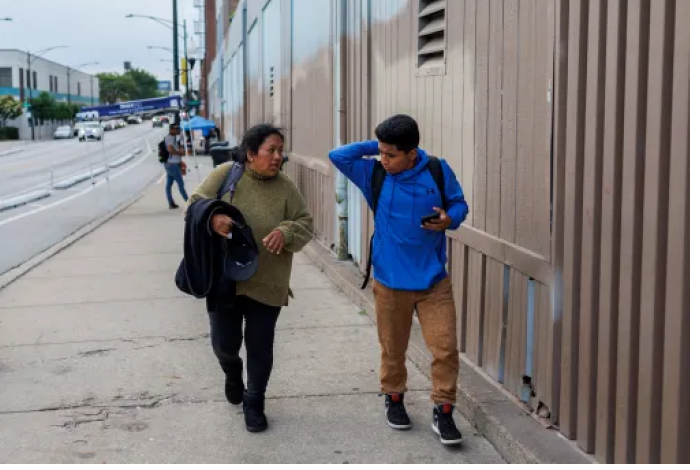
All photos by Armando L. Sanchez/Chicago Tribune
Onward House has been highlighted in the news recently, both by the Chicago Tribune and WBEZ (see previous Announcement). These articles feature Onward House’s work to provide support services to the 43,000 new arrivals and asylum seekers who have been arriving in Chicago for the past two years.
The most recent article, from the Chicago Tribune, is about Jessica Juma, an Ecuadorian immigrant who has been receiving mental health therapy at Onward House. This is a hard story to read, but unfortunately there are many new arrivals who are facing very difficult situations like Jessica’s. Onward House staff have been working with new arrivals since the first bus from Texas reached Chicago in August of 2022. Since then, we have seen firsthand the impacts that these traumatic journeys have had on the lives of new arrivals in Chicago. Recognizing this, we have invested into developing a mental health program in partnership with Cicero Family Services to provide group and individual therapy on a weekly basis.
Here is an excerpt from the Tribune article:
“Juma said their family left their small agricultural community in Ecuador in late September after her 19-year-old and 15-year-old faced faced back-to-back acts of gang violence.
Their family received increasingly threatening calls, so they decided to leave leave Ecuador. They arrived in Chicago in December. On the way here, she and her husband and son were kidnapped in Mexico for five days, she said.
Before her husband went missing, Juma had unpacked her difficult past with Erika Meza, a licensed master social worker with Onward House in Belmont Cragin, who leads group therapy sessions with migrants. Meza said she has an especially close relationship with Juma.

For months, Meza said, the Ecuadorian mother had expressed anxiety over over not having a stable income. Shelter officials were threatening to evict them from the shelter where Juma is currently staying.
Meza said she helped the couple submit their paperwork to work legally in the United States, but [Juma’s husband] Mashiant was still applying for jobs. “He was beginning to get really sad, staying at the shelter,” Meza said.
Juma told her husband to go to group therapy, too, because she said it helped her to understand and cope with her depression, but he hadn’t gone.”
To read the full Chicago Tribune article, click here.